Saturday, April 17, 2010

London Bridge is not falling down


 Friday we went into Lake Havasu to see London Bridge.  In the early 1960s an innovative real estate developer named Robert P. McCulloch bought the exterior granite and masonry portions of London Bridge from (where else?) the City of London.  He had all the pieces numbered for accurate re-assembly here in Arizona.  The actual bridge deck is new, and the entire structure was completed in 1971.


Who knows, perhaps "Jack the Ripper"
stood beneath this very lantern to contemplate
his new relationship with Scotland Yard.


This canal runs under London Bridge and into Lake Havasu


In the evening we went to a local restaurant for the Friday Night Fish Fry and were joined by neighbors Carol and Harold Thornberry, who live near Portland OR and spend winters in Arizona

Today Sandy is planning our travel from here into California and then up the coast of Oregon and over into Montana.  I kind of puttered around the coach: organized some tools and did a few miscellaneous items not worth mentioning. But I did capture this idylic scene along the banks of the Colorado River.


We have not had any good sunsets for the past few weeks so I will end with this floral photo

Stay tuned


Thursday, April 15, 2010

A Good Day in Arizona: Nothing Went Wrong!

A view of the park from the surrounding foot hills


We are camped in Buckskin Mountain State Park alongside the Colorado River. The river is beautiful and the park is very well maintained. There are lots of mature trees planted between RV sites which impart a tranquil and serene atmosphere. It is a pleasure to be in the park.


The Colorado River passes alongside our park


This morning we took a hike into the foothills overlooking the campground. Just across the river is California. As we neared the first vista point on the trail we heard and then saw some of the wild burros that inhabit parts of southwest Arizona and southeast California. Legend says that they are descendants of burros abondoned by gold and silver miners. Too bad we were not close enough for photos, but we could easily see them across the river with our binoculars.

Parker Dam was built between 1934 and 1938


Our next stop was at the Parker Dam on the Colorado River. This is the dam that creates Lake Havasu and is an important source of hydro-electric power. Since 9/11 security restricts access to parts of the dam so getting good pictures was not as easy as I would have liked.  From Wikipedia here are a few facts about Parker Dam.  The dam is a concrete arch-gravity dam that crosses the Colorado River 155 miles downstream of Hoover Dam. It is 320 feet high, making it the deepest dam in the world. The dam's primary functions are to act as a reservoir, and to generate hydroelectric power. Half of the electricity the plant produces is used to pump water along the Colorado River Aqueduct, and the rest is sold to utilities in California, Arizona and Nevada.


Next we drove into nearby Parker and stopped at the local casino. After a nice lunch and about 40 minutes of playing the nickel slots, we quit while we were ahead. We won just a little over $8.00. Woo hoo!
Later in the afternoon we spent quite a bit of time talking to our neighbors Harold and Carolyn from Oregon. They are really friendly people, and we swapped experiences and talked about resources and we all learned new things. One of the best things we learned from talking to them was that our intended next stop in Barstow, CA is kind of a windy and lackluster desert town. So Sandy cancelled that reservation and added the week to the front end of our stay in the next location after Barstow.
Sandy also made some delicious chocolate chip cookies and gave a big bunch of them to the ranger who helped us with our car/tire issue when we came into the park on Tuesday.  My job is to make the remainder of them disappear.


An image from our morning hike

All in all -- a great day on the road.

Stay tuned.

Wednesday, April 14, 2010

Every Cloud Has a Silver Lining and Unique RVs Found Along the Way


When we arrived at Buckskin Mountain State Park near Parker, AZ yesterday we had an unfortunate incident. The campground road takes a somewhat hard turn into the Ranger’s Check-In gate. I somehow managed to get the left-front tire of the Honda up on the curb. When I pulled the motorhome forward the front wheel dropped down to make contact with the pavement – as planned. What I didn’t plan on was having the aluminum TPMS valve stem on the Honda being sheared off. Instant flat tire and instant big problem, but our roadside service Coach-Net came to the rescue.


Last September we had a valve stem shear off on a high curb on the way to Starved Rock State Park in Illinois. It was $180 to replace, plus the long drive to Joliet, IL and back. So now in addition to forking over another $180 , I was looking at a 120 mile one way trip over highways where someone going 50 mph is gonna get a lot of horn honking and dirty looks. The nearest Honda dealer is in Yuma, AZ and I was planning on making the trip in a day or so.


Today we drove to Lake Havasu to Wal-Mart. As we drove there I was complaining about having to make a drive all the way to Yuma to replace a TPMS stem when we already have Pressure Pro Tire Monitors on the Honda. It would be wasted money, time and fuel. Unfortunately, by federal law, a tire dealer cannot make a TPMS system inoperable. We found this out last fall when we had to replace the first Honda sensor. As we were driving this morning, I spotted a Discount Tire store and had Sandy pull in. I went in to talk to one of the service writers. He told me what I expected to hear: that they couldn’t do what I wanted, but they had a solution. They removed the sensing/transmitting portion of the Honda TPMS and permanently affixed it to the inside of the wheel. So now the Honda Tire Pressure Monitoring System is still operating, but we could put regular tire stems on the Honda, thereby eliminating the need to drive 240 miles round trip and incur a big expense. Our Pressure Pros still protect us.


While we were at Discount Tire, we had new tires put on the Honda. We were within 1/32 of an inch from the point where tires should be replaced so we got that taken care of – and got a $100 refund in the process. So problem solved and money saved. I call that a silver lining to a cloud.

Now, for those of you who like to see pictures, over the past eight months I have been taking pictures of unusual RV’s that we have seen. These are unique and one-of-a-kind. Hope you enjoy.


Stay tuned

Tuesday, April 13, 2010

Tires, air compressors and generators

This will fill you in on the last few days in Tortilla Flat, AZ


Just like with real estate,  things wear out on "wheel estate." 

We bit the bullet and got six new tires for Moose in Cottonwood on Thursday April 8 (only $2400 plus the $20 I slapped on Joe, the tire guy, who did a careful job and used the biggest wrench I’ve ever seen to ensure that each lug nut was hand tightened to the Foretravel specs of 450 foot pounds of torque.

The next day we had a new slide out motor ($707 with labor) installed at Al’s RV Service in Glendale. In keeping with the theme of taking care of the coach, we decided to use the next few days to hang around the coach and do some maintenance.


The twisting mountain road to and from Tortilla flat has some tight turns with tree branches too close to the side of the road and our poor coach has picked up a few scuff and light scratches. Some of them run the full length of the motorhome. I‘ve never been fond of the hard work of using rubbing compound and the job was almost overwhelming until I decided to buy a hand-held electric buffer at Walmart. Another tool for me, Yeah! I can use the buffer to apply the rubbing compound as well as to do the finish buffing. Those scratches disappeared like magic. It’s a good thing the clear coat applied over the paint on our coach is extra thick and so far (knock on wood), scratches have not gone into the paint.


My next chore was to change the oil and filter for the diesel generator. I had never done this, so I consulted with friend Gary Omel, who owns the same coach as ours and used to be a technician at the Foretravel factory. Gary gave me a few tips that were really helpful. I spilled less than a teaspoon of old oil. Sandy helped me add the oil and to pour the used oil into the same plastic bottles that held the new. Walmart gladly accepts used oil, which makes for total recycling.


Then very early Monday morning before the sun started to heat up the tires I checked the pressure in all six tires and made adjustments. The two tires on the front axle carry a little over 13,000 pounds so we run with 120 psi in those tires. The four tires on the rear axle carry about 20,500 pounds, but since there are four tires to support this load we only need to fill them to 105 psi. Getting the correct pressure in the tires is a real challenge. Between the gauge on the portable air tank, the gauge on the Pressure Pro tire monitors and a high quality digital pressure gauge I picked up at the Yuma rally, I find a spread of five pounds. Correct tire pressure is critical in a heavy motorhome, so when we were getting new tires I checked my digital gauge against the gauge used by the dealer. The reading was identical. So my standard of reference is my new digital gauge. I can still use and rely on the tire monitor inside the coach that monitors the pressure in each tire as we motor down the road, I just keep in mind that gauge reads about 3 psi lower than actual pressure. Is your head spinning yet?


Cleaning Day -- Monday

Our preference is to give the coach a thorough interior cleaning the day before we travel. That way when we set up at our new location, we start with a clean house. Once the coach was clean, we showered and drove two miles over to Canyon Lake for lunch. We sat on the covered patio and enjoyed a million dollar view of the lake and flower covered mountains. A cool beeze added to our enjoyment.


The old western town of Tortilla Flat is charming but rundown. There are three establishments: a small store that does most of its business selling ice cream cones, a big bar/restaurant with live music several days of the week and a mercantile with more tacky souvenirs than most people collect in a lifetime. But it was nice to have it within walking distance as a reminder of civilization.


It has been a good campground and we have enjoyed our two weeks here, but we won’t be coming back. We have discovered that internet and cell phone service is really important – especially when issues with the motorhome arise.


Stay tuned.

Tuesday, April 6, 2010

A Sunday Drive in the Mountains and Our First Rattle Snake

We crossed Roosevelt Lake Bridge on the way to the dam.  The bridge is the longest two-lane, single span, steel-arch bridge in North America.


We set out in the Honda to see Roosevelt Dam. As the crow flies, the dam is only about 35 miles from our campground – if you don’t mind 20 miles of unpaved washboard roads. We opted for blacktop and about 80 miles. But it was a beautiful drive. Every curve in the road presented a new view or a higher mountain.


We hoped to find a place for lunch along the way. But since this is a really rural area of the southwest the road to Roosevelt Dam only went through two towns, and had very low expectations. For a while it looked like bar food would be our Easter Sunday meal. But, in the small town of Punkin Center we scored a lucky find, big time. The owner herself waited on us. The restaurant was clean and nicely decorated and had been open for all of five weeks. The food was excellent. Everything is made from scratch and Lou’s homemade strawberry cake was remarkable. We’d go back if it wasn’t so far. But if you ever find yourself in Punkin Center, you don’t want to miss Mama Lou’s CafĂ©.


Here is the dam. Some of my parents generation would have called it "that Damn Roosevelt."


After lunch we continued our drive to the dam. The dam wasn’t as imposing as we thought it would be from the size of Lake Roosevelt and its important name, but it was worthwhile nonetheless.


Here is the non-business end of a Western Diamond Back Rattle Snake.  In my opinion the best way to see a poisonous snake is when they are leaving the trail


Not being in any rush. Not having to be home at a specific time and being willing to stop and see something along the way is part of this lifestyle. So we decided to stop and check out the Tonto National Monument in the Tonto National Forest. We were not disappointed.


This is the second “National Monument” we have visited. From what I can surmise, a national Monument is a significant natural site, but does not have the larger importance as does a place like Yellowstone National park or the Grand Canyon.

You are looking at an actual cliff dweller's room.  The supporting log and roof structure are originals dating back to the 1100s AD.


We took a very steep but paved half mile trail up the side of one of the foothills to view the Tonto Cliff Dwellings. This time we got to walk through the actual site.


As I mentioned in a previous blog we are scheduled for service on our slide out tomorrow in Glendale, AZ.  We will do that Wednesday, but if parts are required we will need to return.  We also are ready to purchase tires for Moose.  We have one tire that is problematic and so we would rather replace all six tires at one time for that extra margin of safety.   But, buying the size of tires we need for the motorhome can't be done by rolling into Sears, Walmart or Discount Tire.  The size we use is usually only in stock at stores that sell to larger heavy-duty trucks.  Those facilities are not around every corner and they are not exactly price sensitive.  They know if you are there, that you don't have many options.
+++++++++++++++++++++++++++++++++++++++++++++++++++++++++++++++++++++++++++


Many of you did not get to meet our superb dog, Norton.  Here is a picture I found stored on a thumb drive.  He is still missed.


So that's what's been going on. 

Stay tuned.

Friday, April 2, 2010

Living in the high desert

Life in the Tonto National Forest

We are only about 60 miles south of Phoenix, but it is another world. Up here in the mountains it is very peaceful. The air is crisp and clean. The high desert is in full bloom. There is only a narrow window of a few weeks when everything is in bloom so we are here at the right time. Once the sun begins to set the air become markedly cooler and the shadows make the scenery new again.
Sandy put up her bird feeders and has been rewarded by seeing several new-to-us birds. It really is fun to sit with a pair of binoculars and the National Geographic bird guide and identify a new bird. It often takes a lot of looking to be sure we are correctly identifying the right bird. We also have had a couple of hungry/thirsty Flickers come and drink sugar water out of the Humming Bird feeders. Because we have one-way mesh shades on the windows we can actually be as close as 10 inches to the birds that come to the Humming Bird feeders. Neat experience.

But not all is fun and games here in paradise. Life presents problems and we have to deal with them. Our slide-out room is operating erratically. In 1999 when Foretravel decided to make motorhomes with slide-out rooms, they wanted to do a first-rate job. They emulated the system used for sealing the doors on passenger jets. When our slide goes out a rubber bladder inflates to seal the gap between the slide-out and the side wall of the coach. And when we need to bring the slide-out back in, the bladder deflates, the room retracts and then the bladder again fills with air to make a tight seal. Now the air bladder is not emptying properly and taking way too long to re-inflate. We have an appointment on Wednesday to see what is causing the problem and have it corrected.

Dealing with this problem is not easy when we have to drive 17 miles out of the mountains (30 minutes one way on switch-back, winding roads with 15mph limits on some stretches) to find cell phone service and wi-fi at the public library.

But even with mechanical problems we are in a beautiful location as you can see from the following locations.

The RVs seen at the bottom of the photo are in lower terrace from us.  This campground has three
terraces built into the side of the mountain.  Lovely location.


Stay tuned

Thursday, April 1, 2010

RV Hookups

For my non-RV followers, this entry will be about hooking up our Honda for towing and hooking up water, electric and sewer services.
First, the Honda. There are two basic ways a car can be pulled behind a motorhome. One is to use a dolly that supports the car’s front wheels. The other is to pull the car with all four wheels on the ground. This is what we do. We bought our Honda CR-V because it can be towed with four wheels down without any modifications or damage to the transmission. Not all cars can be towed in this manner, but the list is growing. Saturn and Honda are two that have met these criteria for a long time and that is why we see so many Saturns and CR-Vs behind RVs.
We use a system called Blue Ox to attach the Honda to the back of the coach. The trailer hitch on our motorhome is rated to pull up to 10,000 pounds. The Honda weighs about 3300 pounds, so we well within the limits.

At first it was more difficult to hook up the Honda, but we are much better at it now than we were when we first started living on the road back in September of 2009. We simply pull the Honda close enough to attach the two arms and then put everything in the proper position.

The two thicker black steel cables will keep the Honda attached in the unlikely event that the Blue Ox tow bar somehow separates or breaks. The blue coiled cable is electric and makes the connection between the coach and the car so that turn signals and tail lights operate in concert with those on the coach. The thinner black coiled cable is an air line. A small air-activated piston has been installed out of sight under the Honda’s dashboard. When we step on the service brakes on the coach, the piston applies the same exact amount of force to the brake pedal in the Honda. Pretty neat. The skinny coiled black line (it is connected under the numeral 2 in the license plate) is called the break-away connection. In the unlikely event that the Honda would break away from the coach it will apply the brakes on the Honda and bring it to a stop. I am counting on this never happening. But it is one reason we carry an umbrella insurance policy.

When we arrive at a campground I hook up the electric service first. Campground electricity is sometimes referred to as “shore power.”  George Hatfield, whom we met in Nacogdoches at the Foretravel driving school, built a testing device for me to indicate if the electric pedestal has been correctly wired. So before I do anything, I hook up this device and test the power. The thick black cable will carry up to 100 amps of electricity. It is conveniently stored on a self-winding take up reel in the service bay.


Next I hook up to “city water” which is the popular designation for a campground water supply. We use a sediment filter and a pressure regulator. The filter we use removes some iron and probably 99% of any sand or other solid minerals in the water. The pressure gauge reduces any high water pressure to a safer level so as not to burst any water lines in the coach. Some RVers also use a small water softener.


The last hook up I make is the sewer connection via a 3inch flexible hose often referred to as the “stinky slinky.” The hose enables us to dump our black and gray water tanks whenever necessary. We always wear disposable gloves and are very, very careful to do everything correctly and in sequence.


Now for those times when the campground does not supply electricity we have two options. Each of these can be set to kick in automatically. Here in Tortilla Flat we will be using our 10,000 watt generator frequently – generally from 7:00 a.m. until 8:00 p.m. This engine/generator is behind the front panel of the coach. It hides a small diesel powered generator that will supply as much as 83 amps of electricity.


When the generator is not running, we have a bank of very large batteries which can actually provide enough amperage to run the, TV, interior lights and a few other small appliances for quite a few hours. The refrigerator will automatically switch over to and run off of propane when we turn off the generator. To make all of this happen, we have a permanently mounted device called an Inverter/Converter
that takes 12 volt battery current and steps it up to the 110 voltage needed to run appliances. In the morning when Sandy turns the generator back on the Inverter/Converter will automatically begin to recharge the three 8D batteries. Each of these batteries weighs 161 pounds. These are not the same three batteries used to start the diesel engine.


There are also three solar panels on the roof. These will “top off” the larger 8D “house” batteries.

We’ll be giving this system a good workout for the next two weeks.


We do not have cell phone or internet service here in the Tonto National Forest. You are receiving this courtesy of the wi-fi connection at the Apache Junction Public Library.  While I have the time I thought I would include a few non-technical photos.


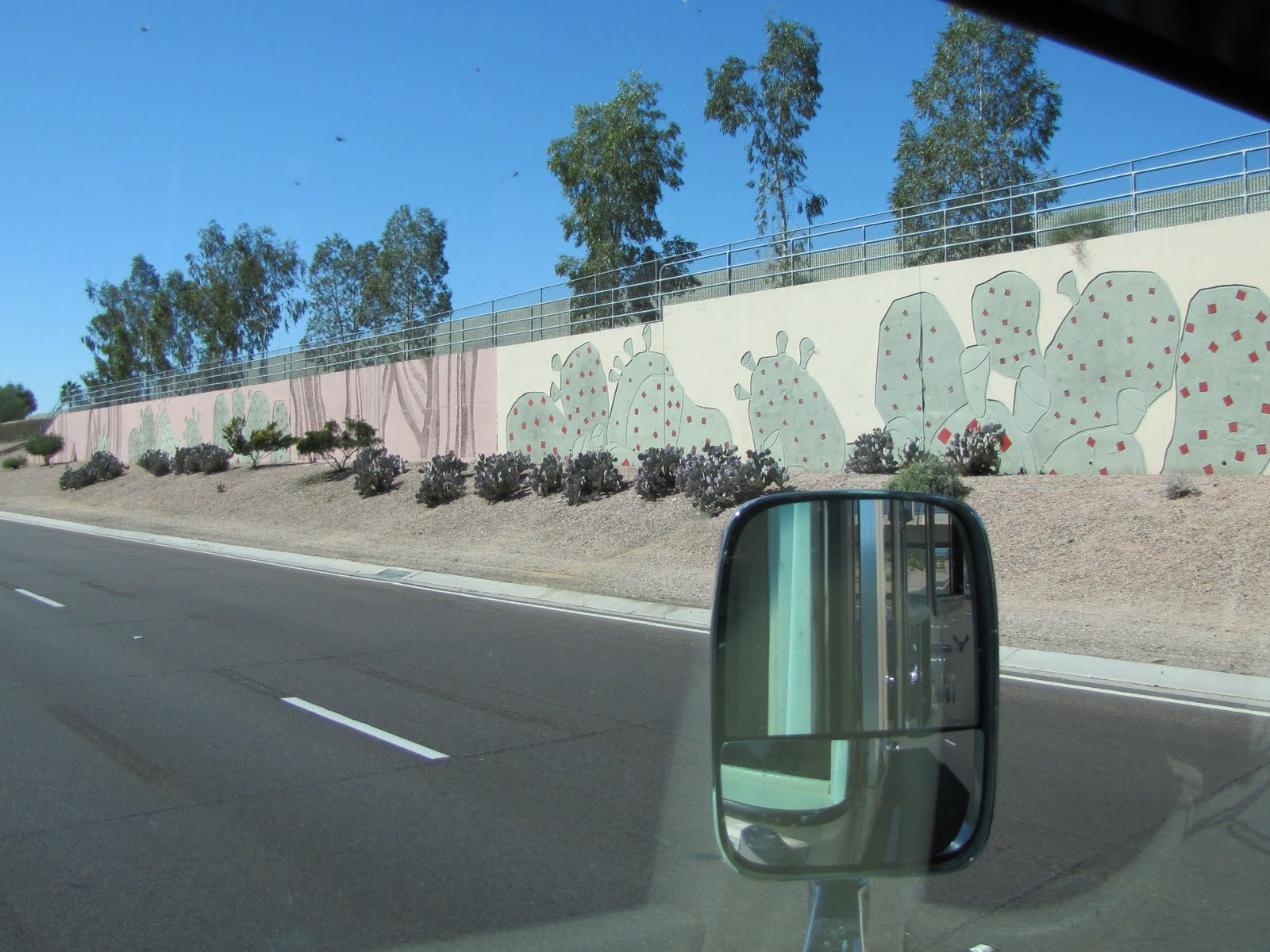
On the way to Tortilla Flat, AZ, we drove around Phoenix. In some areas the retaining walls along the expressways have really attractive e designs molded into the concrete. This is the first time we have seen anything as attractive as these walls. Here are a few examples.

Finally, here is a view taken from inside the motorhome looking out. Not bad.


Stay tuned.