Tuesday, April 6, 2010

A Sunday Drive in the Mountains and Our First Rattle Snake

We crossed Roosevelt Lake Bridge on the way to the dam.  The bridge is the longest two-lane, single span, steel-arch bridge in North America.


We set out in the Honda to see Roosevelt Dam. As the crow flies, the dam is only about 35 miles from our campground – if you don’t mind 20 miles of unpaved washboard roads. We opted for blacktop and about 80 miles. But it was a beautiful drive. Every curve in the road presented a new view or a higher mountain.


We hoped to find a place for lunch along the way. But since this is a really rural area of the southwest the road to Roosevelt Dam only went through two towns, and had very low expectations. For a while it looked like bar food would be our Easter Sunday meal. But, in the small town of Punkin Center we scored a lucky find, big time. The owner herself waited on us. The restaurant was clean and nicely decorated and had been open for all of five weeks. The food was excellent. Everything is made from scratch and Lou’s homemade strawberry cake was remarkable. We’d go back if it wasn’t so far. But if you ever find yourself in Punkin Center, you don’t want to miss Mama Lou’s CafĂ©.


Here is the dam. Some of my parents generation would have called it "that Damn Roosevelt."


After lunch we continued our drive to the dam. The dam wasn’t as imposing as we thought it would be from the size of Lake Roosevelt and its important name, but it was worthwhile nonetheless.


Here is the non-business end of a Western Diamond Back Rattle Snake.  In my opinion the best way to see a poisonous snake is when they are leaving the trail


Not being in any rush. Not having to be home at a specific time and being willing to stop and see something along the way is part of this lifestyle. So we decided to stop and check out the Tonto National Monument in the Tonto National Forest. We were not disappointed.


This is the second “National Monument” we have visited. From what I can surmise, a national Monument is a significant natural site, but does not have the larger importance as does a place like Yellowstone National park or the Grand Canyon.

You are looking at an actual cliff dweller's room.  The supporting log and roof structure are originals dating back to the 1100s AD.


We took a very steep but paved half mile trail up the side of one of the foothills to view the Tonto Cliff Dwellings. This time we got to walk through the actual site.


As I mentioned in a previous blog we are scheduled for service on our slide out tomorrow in Glendale, AZ.  We will do that Wednesday, but if parts are required we will need to return.  We also are ready to purchase tires for Moose.  We have one tire that is problematic and so we would rather replace all six tires at one time for that extra margin of safety.   But, buying the size of tires we need for the motorhome can't be done by rolling into Sears, Walmart or Discount Tire.  The size we use is usually only in stock at stores that sell to larger heavy-duty trucks.  Those facilities are not around every corner and they are not exactly price sensitive.  They know if you are there, that you don't have many options.
+++++++++++++++++++++++++++++++++++++++++++++++++++++++++++++++++++++++++++


Many of you did not get to meet our superb dog, Norton.  Here is a picture I found stored on a thumb drive.  He is still missed.


So that's what's been going on. 

Stay tuned.

Friday, April 2, 2010

Living in the high desert

Life in the Tonto National Forest

We are only about 60 miles south of Phoenix, but it is another world. Up here in the mountains it is very peaceful. The air is crisp and clean. The high desert is in full bloom. There is only a narrow window of a few weeks when everything is in bloom so we are here at the right time. Once the sun begins to set the air become markedly cooler and the shadows make the scenery new again.
Sandy put up her bird feeders and has been rewarded by seeing several new-to-us birds. It really is fun to sit with a pair of binoculars and the National Geographic bird guide and identify a new bird. It often takes a lot of looking to be sure we are correctly identifying the right bird. We also have had a couple of hungry/thirsty Flickers come and drink sugar water out of the Humming Bird feeders. Because we have one-way mesh shades on the windows we can actually be as close as 10 inches to the birds that come to the Humming Bird feeders. Neat experience.

But not all is fun and games here in paradise. Life presents problems and we have to deal with them. Our slide-out room is operating erratically. In 1999 when Foretravel decided to make motorhomes with slide-out rooms, they wanted to do a first-rate job. They emulated the system used for sealing the doors on passenger jets. When our slide goes out a rubber bladder inflates to seal the gap between the slide-out and the side wall of the coach. And when we need to bring the slide-out back in, the bladder deflates, the room retracts and then the bladder again fills with air to make a tight seal. Now the air bladder is not emptying properly and taking way too long to re-inflate. We have an appointment on Wednesday to see what is causing the problem and have it corrected.

Dealing with this problem is not easy when we have to drive 17 miles out of the mountains (30 minutes one way on switch-back, winding roads with 15mph limits on some stretches) to find cell phone service and wi-fi at the public library.

But even with mechanical problems we are in a beautiful location as you can see from the following locations.

The RVs seen at the bottom of the photo are in lower terrace from us.  This campground has three
terraces built into the side of the mountain.  Lovely location.


Stay tuned

Thursday, April 1, 2010

RV Hookups

For my non-RV followers, this entry will be about hooking up our Honda for towing and hooking up water, electric and sewer services.
First, the Honda. There are two basic ways a car can be pulled behind a motorhome. One is to use a dolly that supports the car’s front wheels. The other is to pull the car with all four wheels on the ground. This is what we do. We bought our Honda CR-V because it can be towed with four wheels down without any modifications or damage to the transmission. Not all cars can be towed in this manner, but the list is growing. Saturn and Honda are two that have met these criteria for a long time and that is why we see so many Saturns and CR-Vs behind RVs.
We use a system called Blue Ox to attach the Honda to the back of the coach. The trailer hitch on our motorhome is rated to pull up to 10,000 pounds. The Honda weighs about 3300 pounds, so we well within the limits.

At first it was more difficult to hook up the Honda, but we are much better at it now than we were when we first started living on the road back in September of 2009. We simply pull the Honda close enough to attach the two arms and then put everything in the proper position.

The two thicker black steel cables will keep the Honda attached in the unlikely event that the Blue Ox tow bar somehow separates or breaks. The blue coiled cable is electric and makes the connection between the coach and the car so that turn signals and tail lights operate in concert with those on the coach. The thinner black coiled cable is an air line. A small air-activated piston has been installed out of sight under the Honda’s dashboard. When we step on the service brakes on the coach, the piston applies the same exact amount of force to the brake pedal in the Honda. Pretty neat. The skinny coiled black line (it is connected under the numeral 2 in the license plate) is called the break-away connection. In the unlikely event that the Honda would break away from the coach it will apply the brakes on the Honda and bring it to a stop. I am counting on this never happening. But it is one reason we carry an umbrella insurance policy.

When we arrive at a campground I hook up the electric service first. Campground electricity is sometimes referred to as “shore power.”  George Hatfield, whom we met in Nacogdoches at the Foretravel driving school, built a testing device for me to indicate if the electric pedestal has been correctly wired. So before I do anything, I hook up this device and test the power. The thick black cable will carry up to 100 amps of electricity. It is conveniently stored on a self-winding take up reel in the service bay.


Next I hook up to “city water” which is the popular designation for a campground water supply. We use a sediment filter and a pressure regulator. The filter we use removes some iron and probably 99% of any sand or other solid minerals in the water. The pressure gauge reduces any high water pressure to a safer level so as not to burst any water lines in the coach. Some RVers also use a small water softener.


The last hook up I make is the sewer connection via a 3inch flexible hose often referred to as the “stinky slinky.” The hose enables us to dump our black and gray water tanks whenever necessary. We always wear disposable gloves and are very, very careful to do everything correctly and in sequence.


Now for those times when the campground does not supply electricity we have two options. Each of these can be set to kick in automatically. Here in Tortilla Flat we will be using our 10,000 watt generator frequently – generally from 7:00 a.m. until 8:00 p.m. This engine/generator is behind the front panel of the coach. It hides a small diesel powered generator that will supply as much as 83 amps of electricity.


When the generator is not running, we have a bank of very large batteries which can actually provide enough amperage to run the, TV, interior lights and a few other small appliances for quite a few hours. The refrigerator will automatically switch over to and run off of propane when we turn off the generator. To make all of this happen, we have a permanently mounted device called an Inverter/Converter
that takes 12 volt battery current and steps it up to the 110 voltage needed to run appliances. In the morning when Sandy turns the generator back on the Inverter/Converter will automatically begin to recharge the three 8D batteries. Each of these batteries weighs 161 pounds. These are not the same three batteries used to start the diesel engine.


There are also three solar panels on the roof. These will “top off” the larger 8D “house” batteries.

We’ll be giving this system a good workout for the next two weeks.


We do not have cell phone or internet service here in the Tonto National Forest. You are receiving this courtesy of the wi-fi connection at the Apache Junction Public Library.  While I have the time I thought I would include a few non-technical photos.


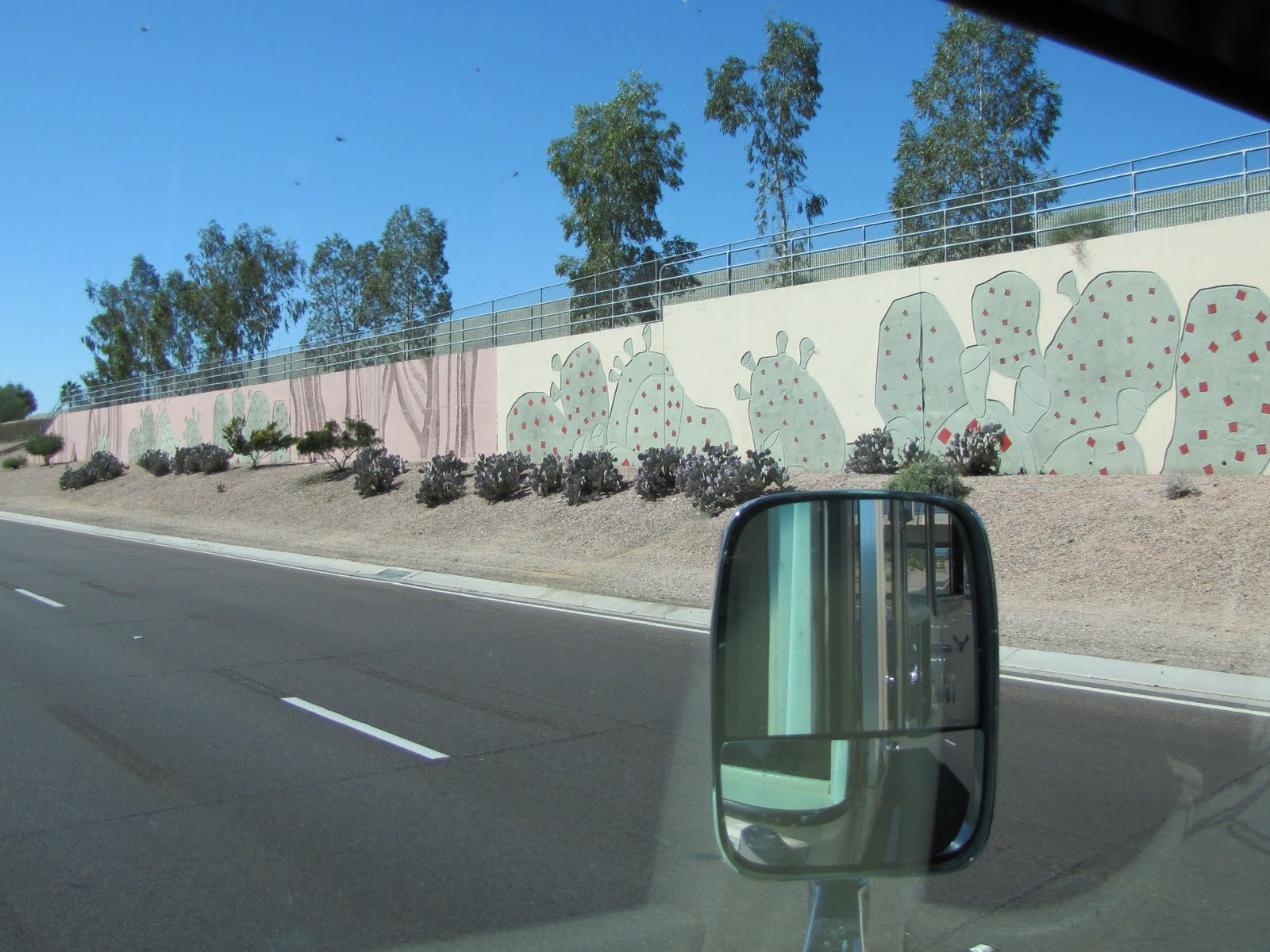
On the way to Tortilla Flat, AZ, we drove around Phoenix. In some areas the retaining walls along the expressways have really attractive e designs molded into the concrete. This is the first time we have seen anything as attractive as these walls. Here are a few examples.

Finally, here is a view taken from inside the motorhome looking out. Not bad.


Stay tuned.


Saturday, March 27, 2010

A Beautiful Day in the Verde Valley

This particular area of Arizona is known as the Verde Valley and for thousands of years it has drawn people here because of its climate, game and the Verde River.  
We noticed this structure on the horizon the first day we were at Dead Horse Ranch State Park.  Today we decided to investigate.  Turns out it is another unique ruin.  This one was built on a large hill in the middle of the valley.  Rooms were built on top of rooms.  Archeologists estimate that as many as 400 people may have lived in the stone structures.  Ofcouse, after about 700 years only the walls remain.

I've talked about these same Sinagua Indians before, so today I'll just show a few more interesting photos.


From the top of the ruin.

Here is a re-creation of the original roof.  Willow branches and/or reeds were laid on top of Cedar or Sycamore logs and then covered with enough leafy branches to keep water out.


Most of us have seen logs or firewood without the bark and have noticed the patterns worms make under the bark.  This "random" pattern is really interesting.  If you look closely you can see the outline of what looks like a primitive drawing of a bird.  I wonder what significance a Sinaguan Indian would have given to this pattern.

 A modern-day fisherman on the Verde River.


An inviting trail near the river.


Spring flowers along side of a camp road.


Earlier this morning we said goodbye to Mike and Bev as they headed north to the Grand Canyon.  Sandy made their departure more enjoyable for them with some fresh-baked blueberry scones.  We plan to catch up with them in October at the huge Albuquerque, NM Balloon Festival.

Stay tuned.


Friday, March 26, 2010

We are having fun

We’re having fun. We’ve taken some neat hikes here at Dead Horse Ranch and back in Sedona. Thursday night we had dinner with new friends Mike and Bev Heine and two of their friends, Paul and Ada Kitchen. We first met Mike and Bev and Bottomless Lakes State Park in New Mexico.


We never know ahead of time how these spur-of-the-moment get-togethers will work out, but we had a great time. Lots of conversation and lots of laughs as we all talked about our full-time lives on the road. The internet and our blogs will help us stay in touch and hopefully meet up again down the road.


Today it was really windy so we decided to take in some of the local history here in Cottonwood, AZ. We went to the Clemenceau Museum in town.  On the grounds of the musuem is the town's first bank.
I found it interesting that the bank advertised their"surplus" which, no doubt, was in cash.  Nothing like advertising what was in the safe.   Note the late hours on Pay Day.


What made this museum so interesting were the local residents who volunteer at the museum.
to work on projects.  This model railroad captures vignettes of Cottonwodd and surrounding towns.  Everything is hand-made and often assembled under magnifying glasses.  Al Barr, Chuck, Lanphere and Bruce Deland were busy kidding each other when we stopped to talk with them. 

In this scene an actual segment of downtown Cottonwood is depicted.  The building were painstakingly made from the sides of cereal boxes.


What is a western town without a saloon?


Sandy spent some time talking with ladies working on quilts and one of the women proudly showed us this sampler she made in 1997.

Then when we left the musuem this piece of tumbling tumbleweed served as a visual reminder that we are indeed in the Old West.

Our personal guide at the museum told us about an old abandoned gold mine in the nearby town of Jerome up in the mountains.


After lunch we drove up the winding and twisting steep  mountain highway filled with switchbacks to a charming old town of 5,000 people who enjoy the many tourists that visit everyday.


Just outside of town we found the Gold King Mine. The miners who started the mine in the early 1900s planned to pull copper out of the mountainside. And while they did just that, they also ran into GOLD. What rotten luck.


Because the mine is closed and dangerous, visitors are not allowed inside, but here is a look into the tunnel from which small ore cars brought out copper and gold.

And here is a mine car filled with copper ore.


The grounds around the gold mine are filled with tons and tons of old stuff, from vintage cars to worn out tools and mining equipment. There is even a working saw mill on the grounds.


For my RV friends who love the Cummins diesel engines in their motorhomes here is an early predecessor built the same year I was born.  Today these great engines slurp our diesel fuel and propel us wherever we wish to go.


This Studebaker electric car was made in
South Bend, Indiana in the early 1900s.  Looks like an old idea is new again.

Also on the grounds are some buildings that were transported from nearby communities and some that served food and drink or provided services to the miners.

Below are two such buildings.


I guess you could describe the services represented in the above two photos as falling into two categories: needs and wants.

Stay tuned.

Wednesday, March 24, 2010

DEAD HORSE RANCH STATE PARK, ARIZONA


We arrived at Dead Horse Ranch State Park early Monday morning after a pleasant and uneventful drive to Cottonwood, AZ.  This campground does not take reservations, so it is first-come, first served.  When Sandy talked to them on the phone they suggested arriving early and so we did.  We got lucky.  We found a great pull-through spot just as the previous occupant was packing up and getting ready to leave.  By the time we unhooked the Honda the space was wide open.

This is the view we have from the back of our site at sunset.

We are getting into more beautiful country and with spring just around the corner the scenery is going to be even more spectacular. The weather is certainly cooperating out here in the West.

Tuesday we drove to a place called Montezuma Castle, which is a National Mounment maintained by the U.S. Department of the Interior.   It is a truly lovely location. It is located alongside of Beaver Creek, and the sound of the nearby spring flow of fresh mountain water layers the area with a soft background sound that adds to the beauty of the grounds.


Archeologists estimate that the Sinauga Indians migrated into the valley around 1150 AD.  No one knows whey they abondoned these pueblos by the early 1400s.  Possible explanations include over-population, disease, tribal conflicts or even changes in weather patterns.  The dwellings seen in the photo are pretty much they way they were found.  However, the masonary dwellings were closed to tourist traffic in 1950 to prevent any further deterioration.
On the monument grounds are many old Arizona Sycamore trees with beautiful bark.  The smaller photo above captures this mottled back that reminds me of a paint by numbers project.

About 75 yards from the base of the clift homes is Beaver Creek which provided a source of fresh water for drinking, cooking as well as for growing crops. 


On the way out of the National Monument we spied a small road side vendor selling native American Indian flat bread.  We split a single order.  We topped the bread with cinnamon and honey. It was delicious.  Sandy kidded the vendor about pulling the dough from a plastic bag, and he quipped back that he just tosses it into a microwave.  We had heard of this native Indian dish from one of Sandy's older sisters, Sharon,  who spends about six months of the year in a fifth wheel RV. The flat bread was a special treat.


Next we drove north to Sedona. The plan was to have lunch and then visit a small local museum.  The scenery went from beautiful to spectacular.  The mountain grades were impressive.  There is a preponderance of red rock in Sedona as you will see from these photos.


When we were in Bottomless State Park in New Mexico we met Mike and Beth Heine and their sweet Labrador Retriever, Lexie.  They have been following our blog and e-mailed us that they were coming to Dead Horse Park.  We met up with them last night and plan to have dinner with them soon and hopefully enjoy an evening camp fire afterwards.

Life is good on the road.

NOTE:  if the pictures are small when you view my blog, just click on them and they will open wider.

Stay tuned.